The Migration Tax: Why 70% of CRM/ERP Replatforming Projects Bleed Budget Past Year One
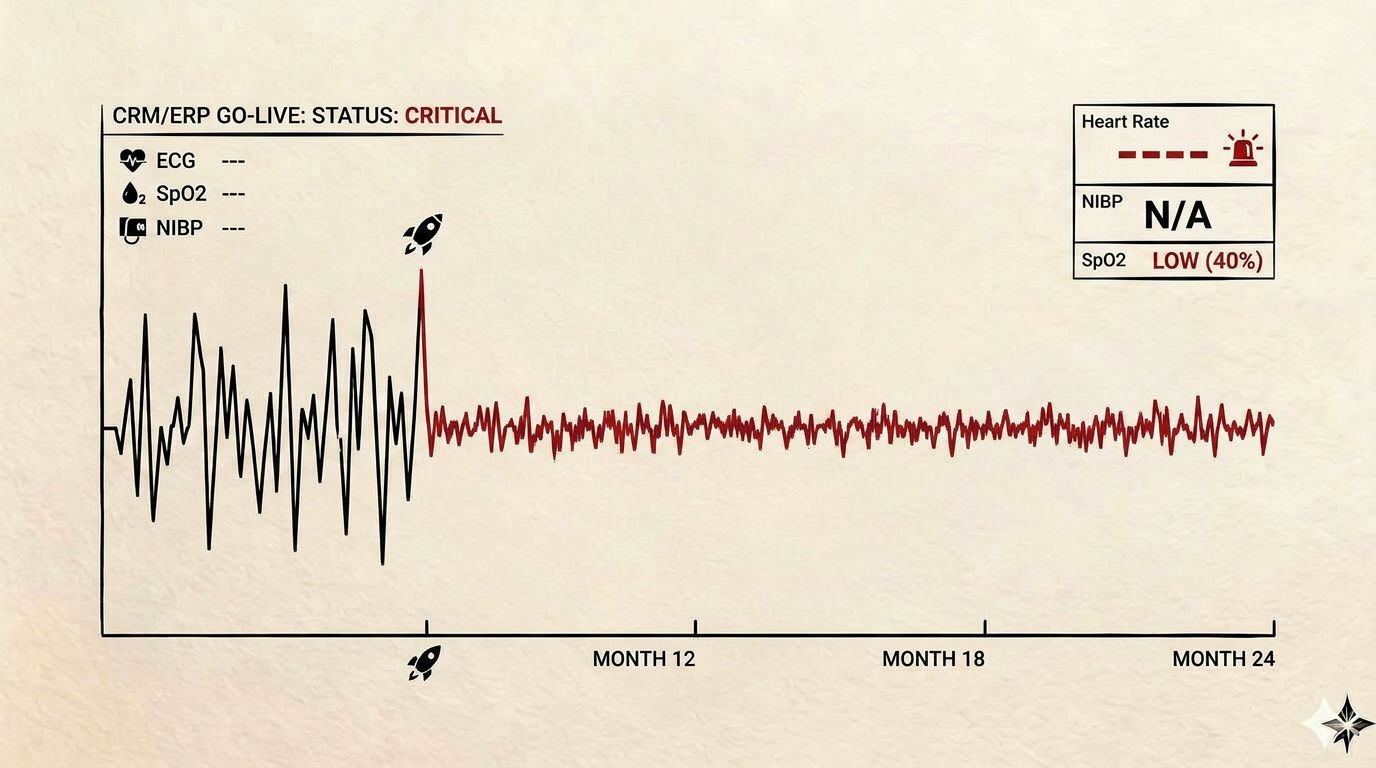
TL;DR: Most CRM and ERP replatforming projects don’t fail at go-live — they fail in the eighteen months that follow, when undocumented data quirks, mapping shortcuts, and validation gaps surface as a slow, recurring bleed. We call this the Migration Tax: the compounding cost of every “we’ll fix it later” decision made during data migration. The way out isn’t more consultants. It’s a portable, declarative transformation layer — like ContentAtlas — that turns one-shot migration scrambles into auditable, reusable assets.
The Statistic Everyone Quotes — and the One That Actually Matters
You’ve seen the headlines. Gartner has reported for years that 55%–75% of ERP projects fail to meet their objectives. CRM isn’t far behind: an analysis by Johnny Grow pegs the CRM failure rate at 55% — measured strictly as deployments that did not achieve their planned objectives. And the underlying data layer is worse: Gartner has repeatedly stated that 83% of data migration projects either fail outright or exceed their budgets and timelines — a figure echoed across LumenData’s analysis with Oracle and countless industry write-ups.
But the statistic that should keep CFOs awake isn’t the failure rate. It’s the duration of the failure.
Panorama Consulting’s 2024 ERP Report puts the median ERP implementation at 15.5 months. About 28% of projects finish slightly late, 11% significantly late. RubinBrown’s industry analysis goes further: 50% of ERP implementations fail on the first attempt, timelines extend 30% beyond schedule on average, and cost overruns often run three to four times the initial budget.
The pattern is consistent. Replatforming projects don’t end at go-live — they bleed into year two. And the meter keeps running.
Meet the Migration Tax
Every shortcut taken during migration becomes a recurring cost. We call this the Migration Tax, and it has four phases.
Phase 1 — Discovery debt. Teams scope the project against the documented data model and underestimate the actual one. The legacy CRM has six “status” fields that mean different things to sales, support, and ops. The ERP has a 12-year-old custom table that nobody owns but three downstream reports depend on. None of this surfaces until mapping starts.
Phase 2 — Mapping shortcuts. Under deadline pressure, teams hardcode transformations into one-off Python scripts or proprietary ETL tool configs. They get the data into the new system. They do not get the logic into a portable, auditable artifact. Six months later, when finance asks “why is the Q3 number different from the old report?”, nobody can trace the path.
Phase 3 — Validation gaps. The cutover passes UAT because UAT tested the happy path. Production exposes the long tail: invalid IBANs, dates in three formats, currency values with the wrong precision (JPY values with two decimals, EUR values rounded inconsistently), phone numbers that look right but don’t dial. Panorama’s 2024 data shows that around two in five organisations exceed budget, with unscoped technology needs as the leading cause — and a large share of those “unscoped needs” are post-cutover data fixes.
Phase 4 — Compounding rework. Every reporting bug spawns a fix. Every fix is a one-off SQL patch nobody documents. The new system slowly accumulates the same data debt that killed the old one — but now with the added cost of two systems running in parallel because finance won’t switch off the legacy reports until the numbers match. They don’t match. They won’t match for eighteen months.
Why Traditional Approaches Compound the Tax
Three default playbooks make the Migration Tax worse, not better.
The system integrator playbook. Big SI firms bill against the project, not against the asset they leave behind. Their mappings live in proprietary tools and tribal knowledge. When the project closes, the lineage closes with it. Panorama’s recent analysis explicitly warns about consultants whose incentives favor license sales and scope expansion over long-term architectural fit.
The custom-scripts playbook. Internal engineering teams write Python or SQL to move the data. It works on day one. It becomes unmaintainable by month six. The engineer who wrote it leaves. Now you have a black-box transformation that nobody can modify without risk — and every downstream report depends on it.
The general-purpose ETL playbook. Tools like Informatica, Talend, and Alteryx are powerful but were designed to feed BI dashboards, not to handle the semantic precision a modern stack requires. They’ll move your data. They won’t natively flag a JPY value stored with two decimals, validate an IBAN against ISO 13616, or distinguish between a test record and a real one without weeks of custom rules.
The result, across all three: you pay the Migration Tax for the entire useful life of the new system.
What the 30% That Succeed Actually Do
The organizations that escape the Migration Tax have one thing in common: they treat the transformation logic as a first-class, portable asset — not as project ephemera.
Concretely, that means:
- The mapping is declarative, not coded. A JSON config that says “this source column becomes this target column, with this transformation, validated against this rule” is inspectable, version-controlled, and survives the engineer who wrote it. A 600-line Python script does not.
- Validation runs against international standards by default. ISO 4217 for currency (including correct decimal precision per currency code). ISO 8601 for dates. Luhn for credit cards. Country-specific structure checks for IBAN. These aren’t nice-to-haves during migration — they’re the difference between an audit pass and a restatement.
- Errors are classified, not just counted. Hard validation failures (an IBAN that fails its checksum) should block the record. Soft corrections (a date in MM/DD/YYYY that needs to be normalized) should flow through with a flag. A migration tool that treats both the same will either block too much or let too much through.
- The artifact survives the project. When the migration is “done,” the mapping config still exists, still runs, still validates incoming data. It becomes the contract between systems, not a one-time deliverable that gets archived.
This is the design principle behind ContentAtlas. Mappings live in a portable JSON configuration. Transformations like clean_currency, standardize_phone, date_standardization, and currency_precision are first-class operations, not custom code. Validators ship with ISO 4217 and ISO 8601 support out of the box. Hard and soft validation are distinguished by design. And when the migration project closes, the transformation logic doesn’t close with it — it stays as a living, auditable layer between your data sources and your new system.
The Bottom Line
Replatforming projects don’t fail because the new system is bad. They fail because the bridge between the old data and the new system is built as throwaway scaffolding and then asked to bear load for years. The Migration Tax is the bill you pay for that mistake — and you pay it every month, in slipped reports, in reconciliation work, in the parallel-systems running cost, in the trust your stakeholders lose when the numbers don’t tie.
You can’t avoid migrations. But you can stop paying the tax.
See how ContentAtlas turns migration logic into a portable, auditable asset →
Further reading from Consuly.ai: