The American AI Illusion: Are You Paying the “Frontier Tax” for Nothing?
We’ve been told the AI race is a three-horse race: OpenAI, Anthropic, and Google. We watch their keynotes, track their benchmarks, and pay their premium API prices because we assume “expensive” equals “the best.”
But while the West builds “Big Brain” models, China is building a “Big Speed” reality.
If you aren’t looking at what’s happening with Moonshot, DeepSeek, and Zhipu AI, you aren’t just behind—you’re overpaying for performance you could get for 10x less.
1. The Cursor Secret: It’s Already “Made in China”
The best example of this shift is hiding in plain sight. Cursor, currently the gold standard for AI coding, recently launched “Composer 2.” The industry secret? It’s widely recognized as a fine-tuned fork of Kimi K2.5—a model developed by Beijing-based Moonshot AI.
While users think they are using a proprietary Western “moat,” they are actually experiencing the power of Chinese reasoning models. Moonshot, along with players like Minimax and Zhipu (GLM), aren’t just “catching up”; they are becoming the invisible engine behind our favorite “Western” tools.
2. Inference Arbitrage: 10x Cheaper, 95% as Good
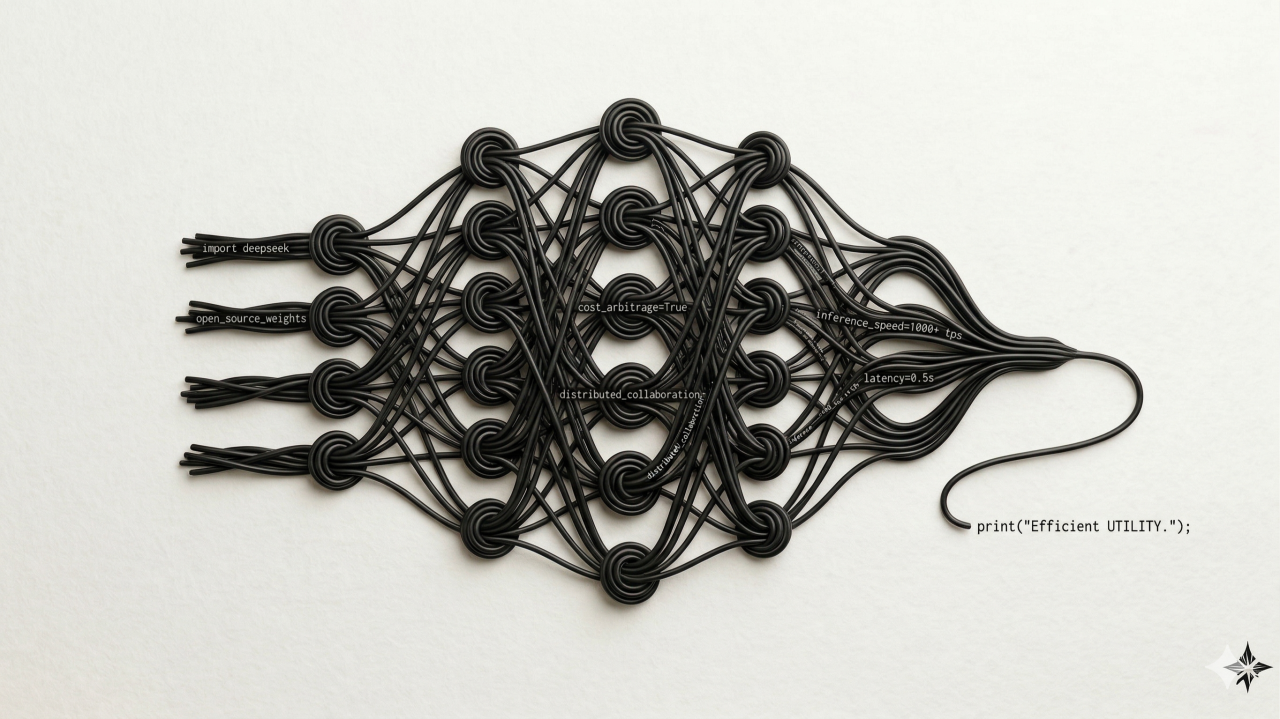
The “Big Brain Trap” in the US is the obsession with closed-source, high-margin models. Meanwhile, China is winning on Inference Arbitrage.
- The Cost Gap: Models like Kimi K2.5 or Minimax 2.7 are often 10x less expensive than GPT-5.4 or Claude Opus 4.6.
- The Benchmarks: Most reasoning benchmarks (GPQA, AIME) now show Chinese models trailing the US “Big Three” by only a few percentage points.
For 99% of business use cases, paying a 1000% premium for a 5% gain in reasoning isn’t a strategy—it’s a lack of financial discipline.
3. The Speed War: 1000 Tokens per Second
We are entering the era of “Instant AI.” While we’ve been trained to wait for the slow, “typewriter” output of 20-50 tokens per second from the majors, a new frontier is emerging.
Take Mercury 2 (by Inception Labs). Using a diffusion-based reasoning approach, it hits over 1,000 tokens per second. This is the benchmark China is racing toward. When you combine that speed with the upcoming releases of DeepSeek-R2 and Qwen-Next, the latency gap becomes a chasm.
If your AI takes 10 seconds to “think” while your competitor’s Chinese-backed agent responds in 0.5 seconds, who do you think wins the user?
4. Visual Dominance: The Video/Photo Flip
It’s not just about text. Look at the video generation space. While we wait for Sora’s full release, Chinese models like Kling AI, Wan 2.1, and Tencent’s HunyuanVideo are already dominating.
Unlike the closed-loop US models, many of these are Open Source (or “Open Weights”). This creates a massive collaborative ecosystem that iterates 5x faster than any single lab in San Francisco can.
The Bottom Line
The “AI Battle” isn’t about who has the most parameters; it’s about who has the most accessible utility.
By choosing open collaboration and aggressive pricing, China is turning AI from a “luxury boutique” service into a “utility” commodity. If you’re still building your stack solely on US frontier models, you might be falling into the biggest Big Brain Trap of all: ignoring the revolution because it didn’t start in Silicon Valley.